
India is preparing to resume the Kailash Mansarovar Yatra, a pilgrimage to Mount Kailash in Tibet, after a three-year hiatus. The decision comes as part of efforts to improve relations between India and China, which have been strained since a military standoff in 2020. The two countries have also agreed in principle to resume flight services between them.

The Global Times, a prominent state-run Chinese media outlet, published an article titled "China and India are cooperation partners, not rivals: Xi," highlighting President Xi Jinping's remarks about the bilateral meeting, saying, "as long as the two countries stick to this overarching direction, China-India relations can sustain steady and long-term growth."

If Beijing succeeds in this multipronged effort to challenge the current dominant power, it will have not just economic but political and security consequences. There is no let-up in the South China Sea nor any de-escalation moves on the India-China border. This portends to ominous signalling from Beijing, observes China expert Srikanth Kondapalli.
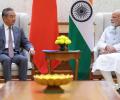
'New Delhi is not naive about its foreign policy choices.'

A meeting with Chinese President Xi Jinping on the sidelines of the SCO summit is being planned.
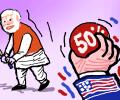
'Things may get much worse before they get better,' predicts Ajay Chhibber.
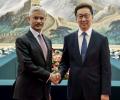
India and China should build on 'good progress' in normalising the bilateral ties to address border-related issues including de-escalation, and it is essential to avoid 'restrictive trade measures and roadblocks', External Affairs Minister S Jaishankar said on Monday during talks with his Chinese counterpart Wang Yi.

The BRICS nations condemned the Pahalgam terror attack, advocated for a zero-tolerance approach to terrorism, and criticized rising tariffs during their summit in Rio de Janeiro. They also addressed global challenges and called for reforms in international institutions.

United States President Donald Trump has warned that countries aligning with the BRICS economic bloc will face additional 10 per cent tariffs on their goods, as he seeks to protect the dollar's global dominance.

India's Foreign Secretary Vikram Misri will travel to Beijing for a two-day trip beginning Sunday, marking the second high-profile visit from India to China in less than one-and-a-half months. The visit comes amidst ongoing border tensions and follows a recent disengagement pact between the two countries in eastern Ladakh. The Foreign Secretary-Vice Minister mechanism meeting will focus on the next steps for India-China relations, including in the political, economic, and people-to-people domains. The decision to revive this bilateral mechanism was taken at a meeting between Prime Minister Narendra Modi and Chinese President Xi Jinping in Kazan in October.

'The logic every one of our neighbours must realise is that working with India will give you benefits, and not working with India has a cost.'

Chinese Foreign Minister Wang Yi said that it is imperative for the two sides to view each other as partners and opportunities rather than rivals or threats, and invest their valuable resources in development and revitalisation.
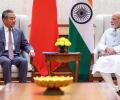
China's Foreign Minister Wang Yi expressed China's anticipation for Prime Minister Narendra Modi's visit to the Shanghai Cooperation Organisation (SCO) summit, emphasizing the importance of strong India-China relations and mutual cooperation.

Prime Minister Narendra Modi and Chinese President Xi Jinping are expected to hold bilateral meetings on the sidelines of the SCO summit in Tianjin, as both nations look to strengthen ties amid global trade tensions.

Special Representatives of India and China will hold the 16th round of boundary talks in Beijing on Friday, the first such meeting under the new Chinese leadership, to make another bid to move forward on the resolution of the vexed dispute.
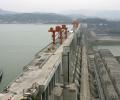
China has approved the construction of the world's largest dam on the Brahmaputra River in Tibet, close to the Indian border. The USD 137 billion project, which is expected to dwarf even China's own Three Gorges Dam, has raised concerns in India and Bangladesh, the downstream riparian states. Concerns in India are centered around China's potential to control water flow, potentially enabling the release of large amounts of water to flood border areas in times of hostilities. The dam is part of China's 14th Five-Year Plan, and the Chinese government claims that the project is safe and prioritizes ecological protection.

Why can't the Indian government propose to the Chinese a corridor circumambulating the Holy Mountain where people from both sides could perform the yatra again? asks Claude Arpi.
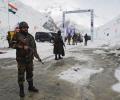
With Beijing remaining intransigent on the withdrawal of additional troops deployed by the People's Liberation Army (PLA) since the deadly border clash in 2020 in eastern Ladakh, India's bilateral ties with China remained frozen in 2023 with no forward movement on the horizon despite several rounds of diplomatic and military talks.
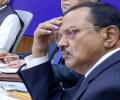
National Security Advisor Ajit Doval arrived in Beijing on Tuesday to take part in the India-China Special Representatives' talks to be held on Wednesday aimed at restoring the bilateral ties stalled for over four years' due to the military standoff in eastern Ladakh.
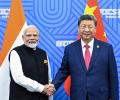
The Galwan clash occurred six months after the Doklam disengagement and two high-profile meetings. India should not be caught by surprise once again, asserts former foreign secretary Shyam Saran.

India's Foreign Secretary Vikram Misri has arrived in Beijing for a two-day visit during which he will hold talks with Chinese officials. The visit comes amid ongoing efforts to de-escalate tensions along the Line of Actual Control (LAC) in eastern Ladakh and to resume bilateral cooperation in various fields, including the Kailash Mansarovar Yatra.

'A less tense US-China relationship would make Beijing less likely to provoke India -- including on the border -- in retaliation for its close defence ties with the US.'

Situated at a height of 15,200 feet above sea level, the pass sits on the top of a craggily formed Himalayan range that separates the Tibetan plateau from the Indian sub-continent.
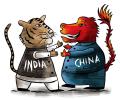
India and China achieved a major milestone this year when their bilateral trade crossed the landmark figure of $100 billion but it did not generate any fanfare in both capitals as the two Asian giants are going through a "particularly bad patch" in their relations due to a set of actions by Beijing in violation of agreements that led to the military standoff in eastern Ladakh. Starting with a modest $1.83 billion in 2001, the bilateral trade crossed $100 billion-mark in the first 11 months this year, a significant milestone for which the two countries carried out campaigns to boost trade and build it as a major stakeholder to improve the relations between two nations, whose ties otherwise remained frosty over the festering boundary dispute and strategic rivalry. According to last month's data from China's General Administration of Customs (GAC), the India-China bilateral trade totalled $114.263 billion, up 46.4 per cent year-on-year from January to November 2021.

China supplied more than $20 billion worth of arms to Pakistan. These include 20 J-10CE and JF-17 Block III fighter aircraft, Wing Loong drones, frigates, submarines, Hongqi HQ-9P surface-to-air missiles, 240 PL-15E air-to-air missiles, LY-80 air defence systems, ZDK early warning aircraft and other weapons.

'My father's life sends a message that there are positive things happening between India and China, no matter what happens at the border.'

Qin, who is visiting New Delhi to attend the G20 Foreign Ministers meeting on Thursday, is expected to meet Jaishankar on its sidelines though the foreign ministry here is tight-lipped about it.
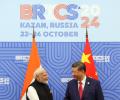
'Don't play the American game... India is too big for a US game.'

The Ministry of External Affairs (MEA) has announced that India and China have reached an understanding to resume the Kailash Mansarovar Yatra in 2025. While an understanding has been reached, the modalities of the pilgrimage are yet to be firmed up. The Yatra has been suspended since 2020 due to the COVID-19 outbreak and non-renewal of Yatra arrangements by the Chinese side.

As of now, in the case of China's border dispute with India, China is not likely to lose much if it does not resolve the dispute. In fact, the unresolved border dispute has much to offer to China, says Sana Hashmi.

'With continued focus on votes, upcoming by-polls and purchasing politicians, the political hierarchy has little time for national defence.' 'They would do well to heed a veteran scholar, who says, "There will be war with China in the next few years. The next full scale war will have the involvement of Pakistan and terror elements, insurgents and intelligence assets operating inside India",' warns Lieutenant General Prakash Katoch (retd).

Ahead of the opening of the Nathu La pass later this month, the government has finalised the list of items for trade with China from the border point between Sikkim and Tibet.

India and China on Tuesday discussed the recent spate of incursions and ways to maintain peace and tranquility along the Line of Actual Control in the border areas.

'The lesson Beijing would have learned is that there is, cost-benefit wise, no better option than to keep the Pakistan military supplied with its most advanced armaments, certain that in hostilities with India these would be used for maximum effect.'

External Affairs Minister S Jaishankar reiterated India's stance on the Depsang and Demchok areas in Ladakh, stating that Indian security forces will patrol up to the historical limits. He also firmly rejected Nepal's alleged territorial claims, asserting that India's position on the border is clear and will not be altered. Jaishankar also addressed the situation in Myanmar and India's 'Neighborhood First' policy, highlighting the government's commitment to regional cooperation and development.

'Given China's past behaviour and their territorial claims, should we be sceptical regarding China's willingness to adhere to these agreements fully? The answer is yes.' 'As Ronald Reagan famously said in the context of the SALT talks, 'Trust, but verify!' India should also do the same.' 'This has already begun with foot patrolling, drones, satellite imagery and so on. India's military deployment did mirror China's and will continue to do so in the future.'

'The border deal offers a hedge for India against Trump's unpredictability when it comes to his approach to competition with China.'

Chinese ambassador to India, Xu Feihong, on Wednesday expressed hope that the recently completed Indo-China border disengagement in Eastern Ladakh would smoothen relations and pave the way for a better understanding between the two neighbours in the days ahead.
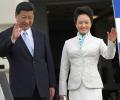
'India and China have to make concrete progress with regard to the border issue, addressing the trade deficit, and facilitating people-to-people interactions. This has to happen in the next two, three years.' China expert Tansen Sen tells Sheela Bhatt/Rediff.com how India and China can take their relations to the next level.
 © 2026 Rediff.com - Advertise with us - Disclaimer - Privacy Policy - Sitemap - Feedback - About us - Terms of use - Grievances